Save on protection when you buy hosting

Order a VPS or dedicated server together with dedicated AntiDMCA and get 30% off copyright-abuse protection

Promotion ends in:

00 days
:
00 hours
:
00 minutes

Order
promo-1
Take it longer — pay less

Pay less every month on any NetWall product with a 3+ or 6+ month plan. Ask your manager how much you can save on each product

Promotion ends in:

00 days
:
00 hours
:
00 minutes

Order
promo-2
Try AntiDMCA for free

Test AntiDMCA protection with a trial period:

  • AntiDMCA Shared — up to 10 sites free for the first month
  • AntiDMCA Dedicated — 14 days free

Promotion ends in:

00 days
:
00 hours
:
00 minutes

Order
promo-3

Offshore VPS and Dedicated Servers From $40 a Month, Paid in Crypto, With Unmetered Traffic

View Servers
Offshore VPS & Dedicated Servers From $40/Month: Crypto Payments and Unmetered Traffic

    netwall runs offshore servers in five countries: the United States, the United Kingdom, the Netherlands, Germany and Czechia. Rental starts at $40 monthly for a VPS, or $145 for a dedicated machine, on a plain account registration without a KYC check and a bill paid in crypto, with DDoS filtering rated to 200 Gbps in that price. Keeping abuse mail away from the machine that serves your site is a separate add-on, the AntiDMCA balancer, priced from $5 monthly per protected domain.

    This page sets the ceiling of what a host can do about complaints and takedowns for a project in these niches: what comes in the price, what runs without extra conditions or a migration, and where your own responsibility starts. None of our five countries is on anyone’s list of offshore havens, and we don’t dress them up as one. What keeps a high-risk project online with us is the way complaints are routed, and that routing works the same in all five locations.

    netwall server locations in the US, UK, Netherlands, Germany and Czechia

    What is included in offshore hosting at netwall?

    Offshore hosting at netwall gives every VPS and dedicated server unmetered traffic on a network connection rated up to 1 Gbps, plus a dedicated static IPv4 address of its own. Linux servers ship with any distribution you ask for, Ubuntu by default, and Windows Server is available on request. Complaint routing is the one part priced separately: the AntiDMCA balancer costs from $5 a month per protected domain in its shared form and $150 a month as a dedicated one.

    How an abuse report finds a server

    Most people filing a complaint have no idea who hosts the site they are complaining about. It takes them about a minute to find out. The domain resolves to an IP address, and a WHOIS lookup on that address in the regional internet registry returns the organisation holding that range of addresses, together with the email address it lists for abuse reports. North American addresses usually sit in ARIN’s database, European ones in the RIPE NCC’s. Takedown agencies run the same lookup by script and send their notices in bulk.

    From there the report lands with that organisation, and the country on the invoice stops mattering. A host that ignores reports about its own addresses doesn’t make them go away. Complainants then go to the provider that connects the host to the rest of the internet, and that provider’s contract comes with usage rules. Once that provider decides its customer is breaking those rules, it can null-route the address, which means silently dropping all traffic sent to it.

    A server in a so-called lenient country, with its own IP sitting in public DNS, is reachable through the same chain as a server in Ohio. The country shows up at only one step, the host’s own decision on whether to act, and the network provider above the host can overrule it.

    Does the DMCA apply outside the US?

    Section 512 of the US Copyright Act is where the DMCA notice-and-takedown procedure comes from. It works as a safe harbour: a service provider that removes material promptly after a valid notice is shielded from damages for what its users published. That shield only matters to providers a US court can reach, which is why US-connected hosts tend to act on notices fast and often without reading them closely.

    A provider with no US connection has little reason to follow that procedure. Stepping outside the procedure is a different thing from stepping outside copyright, though, and this is the half of the argument most offshore pitches skip. The Berne Convention obliges each member state to protect works originating in the other member states, and all five of our countries have signed it. A rights holder can still take a case to a national court.

    What changes outside the DMCA is the channel. A bulk notice produced by a scanning service loses the legal pressure that pushes a US host to act on it the same day.

    What the AntiDMCA balancer changes in that chain

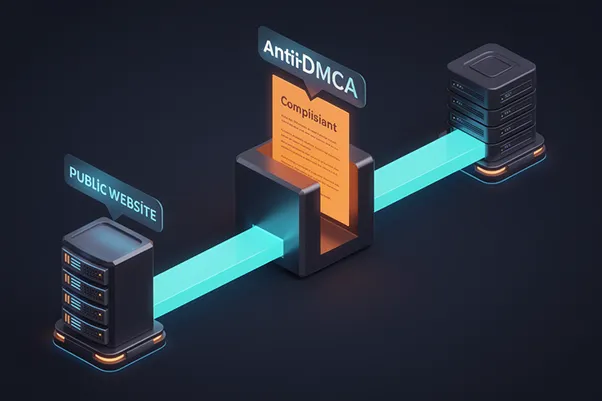
    Your domain points at the balancer instead of at your server. Visitor traffic passes through the balancer to the machine with your content, and that machine’s own address, the origin IP, isn’t published in your DNS records. When a complainant runs the registry lookup, the trail stops at the balancer, so the report arrives on the balancer side and our admin reads it there. The provider behind your server gets nothing to forward. The full mechanics, including how notices are sorted, are laid out on DMCA Ignored Hosting.

    Automated bulk notices stop at the balancer. In adult, iGaming and crypto niches a large share of them come from competitors instead of rights holders, and the balancer doesn’t need to tell the two apart to keep either away from the origin. When a genuine notice also lands in our inbox, beyond the copy sent to a search engine, the admin flags it, tells you what arrived and allows time to handle it before anything changes. Nothing is suspended or deleted automatically.

    Copyright mail is only part of the load. Reports about the content itself, the kind a rival or an opponent of a whole product category sends to get a site pulled, arrive at the balancer on the same path.

    The balancer carries its own DDoS protection, so putting it in front of a site doesn’t create a new weak point. It attaches to a site hosted with us or with any other provider, and you don’t have to migrate first. One detail worth knowing from real setups: if the domain pointed straight at the server before the balancer went in, public services that store old DNS records still show that address. An origin whose IP has never been published is cleaner, and each netwall VPS comes with its own dedicated static IPv4.

    How an abuse report reaches a server directly and how the AntiDMCA balancer stops it

    Why the balancer’s location stays unpublished

    A named location would give complainants a second address to lean on. Right now a complaint has one destination, the balancer, where it gets read and sorted. Publish the country and the facility, and anyone set on taking a site down could skip the balancer and go after the facility or the provider that connects it, the same escalation path described above. We can say the balancer runs outside DMCA jurisdiction; the country itself is the one detail we keep off the website.

    Where each type of complaint ends up

    Complaint Where it arrives What happens next
    Automated bulk takedown notice from a scanning service The balancer Stops there; the origin server never receives it
    Genuine notice sent by email The balancer, then our admin You get notified and have time to react; nothing is removed automatically
    Abuse report about the content, unrelated to copyright The balancer Handled on the same path as copyright mail
    Search engine copyright request Google or another search engine, directly The search engine decides by its own process whether to drop the URL from results
    Court order from a court with authority over the site or its operator Legal channels, outside the balancer Carries legal force an abuse email lacks; hosting policy doesn’t override it

    The search engine row is the one clients underestimate. Google runs its own copyright removal process, and a delisted URL loses its traffic even while the server keeps answering every request.

    Who needs offshore hosting?

    Adult sites and iGaming affiliates sit where complaint volume runs highest, and a lot of it comes from rivals. For casino and betting operators there is a licensing angle as well: servers in any of our five countries suit licences that don’t require hosting on the regulator’s own territory, while holding and complying with the licence stays the operator’s responsibility.

    SEO teams running private blog networks, sets of sites built to push links toward a main commercial site, have a different worry. One site in the network collecting complaints shouldn’t drag the other properties along with it. Secure hosting, our product built for SEO sites and private blog networks with several layers of protection, starts at $40 a month.

    Crypto projects often fail onboarding at mainstream hosts before anyone looks at the site. Card processors behind conventional billing flag crypto-adjacent accounts, and a no-KYC signup paid in crypto removes that step entirely.

    Independent publishers make the clearest case for complaint routing. When the usual response to a story is a takedown request rather than a rebuttal, that request reaches our admin first, and nothing is taken offline automatically while it is reviewed.

    NETWALL will help you

    Tell us about your case and we will offer you a solution

    Get Started

    How much does offshore hosting cost?

    Product Starting price Countries Best fit
    VPS $40/month (US); $45/month in all five countries US, UK, NL, DE, CZ One project that needs its own IP and full control of the server
    Dedicated server $145/month NL and DE from $145; US and UK on larger configs High-traffic sites, or several projects consolidated on one machine
    Secure hosting $40/month SEO sites and private blog networks
    AntiDMCA balancer, shared (add-on) $5/site/month Works with a server in any location Trial runs, or a few sites with modest traffic
    AntiDMCA balancer, dedicated (add-on) $150/month Works with a server in any location A network of sites, or traffic that outgrows a shared balancer

    VPS configurations range from 2 to 8 cores, 4 to 16 GB RAM and 30 to 80 GB SSD. On dedicated hardware the entry point is a Xeon E3 server with 32 GB RAM, and the largest configurations reach 512 GB RAM. Traffic is unmetered, over a network connection of up to 1 Gbps.

    Always-on DDoS filtering with capacity to 200 Gbps, including floods of junk requests to the site itself, is part of the VPS and dedicated price. Most servers are handed over within a day; complex builds may need a second business day, and support helps with installation and with picking a location. Configurations and current prices for every product are listed in the tariff selector.

    Signing up and paying

    Jurisdiction and identity are separate questions, and this page deals with the first. On the identity side, signup skips identity documents entirely, and invoices go through cryptocurrency instead of a card. Support answers panel tickets and a Telegram chat. How much of that stays private, and where crypto payments stop being anonymous, is broken down on Anonymous Web Hosting.

    Why this is not bulletproof hosting

    In the hosting trade, “bulletproof” means a provider that keeps any customer online, phishing kits and malware control servers included, and ignores abuse reports from everyone, police included. Networks run that way end up with their IP ranges on blocklists and, sooner or later, with their own network providers cutting them off. netwall doesn’t operate like that. Everything listed above is what the hosting layer closes for you; the five points below mark the exact line where that work ends and yours begins:

    • A search engine handles a genuine copyright complaint on its own. A site can lose positions over a notice we never passed to the server, so ignoring complaints is a choice that comes with ranking risk.
    • Criminal material is not accepted under our terms, and no routing changes which laws apply to it in the country where the server stands.
    • A court order is a legal instrument, while an abuse email is a request. Hosting policy decides how to answer requests and has no standing against orders.
    • DDoS filtering covers netwall servers. A site hosted elsewhere and attached only to the balancer gets complaint routing without DDoS protection.
    • Nothing on this page is legal advice. A dispute that reaches lawyers needs a lawyer licensed in the relevant country.

    FAQ

    No. Offshore concerns jurisdiction: whose complaint procedures and whose courts can reach the machine. Anonymous concerns identity: how much of the project leads to the person behind it. A server rented under your own name in another country is offshore without being anonymous.

    Renting a server outside your home country is legal in itself. The content on it still falls under the law of the country where the server runs, and copyright applies there with or without DMCA procedure. For iGaming, the licence and compliance with it remain the operator’s job. This is general information, not legal advice.

    Not through the flag. Location affects response time, so a server close to your visitors loads faster for them, and load speed does feed into rankings. The larger SEO risk on high-risk sites is a search engine’s own copyright process, which runs independently of any host.

    No, it’s an add-on. The shared balancer is billed per site from $5 monthly, a dedicated one is $150 monthly, and both work in front of our servers as well as third-party hosting.

    Only if the site runs on a netwall VPS or dedicated server, where filtering with 200 Gbps of capacity comes in the price. The balancer itself is DDoS-protected, so it won’t fall over under an attack aimed at it. A site hosted with another provider and attached to the balancer gets complaint routing but no DDoS protection for its own server.

    Start with where your visitors are, then check which plans exist there. The $40 VPS is available in the US, the $45 plan runs in all five countries, and the cheapest dedicated servers are in the Netherlands and Germany. Complaint routing through the balancer behaves the same whichever country you pick, and support will help narrow the choice down.

    Yes, Windows Server is available on request. Linux servers get any distribution you name, with Ubuntu installed by default.

    Usually within a day. Non-standard configurations can stretch to two business days, and support can help with the initial setup.

    Contact us